Digital Identity redux

CC BY-NC-SA 2.0 Ed Yourdon (Flickr)
In the course of my work over the past few years I have circled back, again and again, to digital identity. In my research and teaching, when invited to speak with or facilitate workshops for staff and students (on open educational practices, social media & academia, digital literacies, etc.), and when working with young people and youth groups – at the core almost always are questions about [digital] identity. As my understanding and ideas have evolved I’ve blogged about digital identity, explored the concept with students, and it has been the focus of my PhD research from the start. And still I wonder – thinking occasionally (and wryly) of T.S. Eliot’s words:
We shall not cease from exploration
And the end of all our exploring
Will be to arrive where we started
And know the place for the first time.
Last week I participated in Day 3 of the ePortfolio conference at Dublin Institute of Technology. The conference was part of a National Forum-funded project: An ePortfolio strategy to enhance student learning, assessment & staff professional development. The focus of the conference was not on eportfolio applications per se, but on eportfolios as a focus for learning design and pedagogies that support students and staff in developing broader digital literacies and digital identities, within and beyond formal education. I missed some of the excellent sessions (all videos will be available soon on the ePortfoliohub site) but two highlights of the day for me were Helen Beetham’s keynote Digital identities: resources for uncertain futures? (summarised in her blog) and Bernie Goldbach’s workshop Creating collaborative portfolio objects – two posts well worth reading.
At the conference I also facilitated a session, Exploring our digital identities. Over the past two months I’ve facilitated several workshops for students and staff, separately and together, to explore issues related to digital identity. Although each discussion is unique, I often use versions of the presentation I shared at the ePortfolio conference:
(or this slightly different version for student workshops: social media, digital identity and me)
Although this is structured as a short presentation it’s intended to be a conversation starter, a prompt for deeper discussion. I’m particularly interested in the questions and concerns that students and staff bring to these sessions. At a recent workshop, for example, undergraduate students raised questions about the Right to be Forgotten ruling, managing privacy settings, being authentic online, finding a blogging ‘voice’, navigating different networks, dealing with FOMO, what potential employers are looking for, and how best to use specific tools like LinkedIn and Twitter during the transition from student to graduate.
Within the workshops, I tend not to discuss the mechanics of using specific tools. There are already some terrific resources for setting up and using social media and open tools, and I am always happy to share these. Instead, I invite participants to consider deeper questions, such as:
- What are my networks right now?
- What conversations do I want to be a part of?
- Who do I want to share with?
- Who do I want to I share as?
- What are some ways that I might manage my different private/public and social/scholarly conversations, networks and identities?
- To what extent, and in what contexts, might I separate or mix these conversations and identities?
And for educators, a few further questions:
- How can I support and empower students in developing their digital literacies and digital identities?
- What learning spaces do I create with and for learners? Who am I, and who are we, in those spaces?
- How best can I model and nurture democratic practices, particularly in open online spaces?
There is a growing body of work in the areas of digital identity, digital literacies and digital capability that supports this process of open inquiry. The strength of much recent work is that it is increasingly integrated, for example: focusing not just on students or staff, but on students and staff together; broadening the definition of ‘staff’ to include adjunct, technical, library, and learning support staff; and looking beyond institutional roles and practices to consider social and civic as well as scholarly and professional identities.
This is the approach taken by the All Aboard project here in Ireland, for example, in addressing the challenge of the national Digital Roadmap to build our digital capacity. All Aboard has published a comprehensive review of existing digital literacies/competency models in their report Towards a National Digital Skills Framework for Irish Higher Education as well as a digital capability framework for Irish higher education in the form of an interactive Metro Map:

CC BY-NC AllAboardHE.org (click image for interactive version)
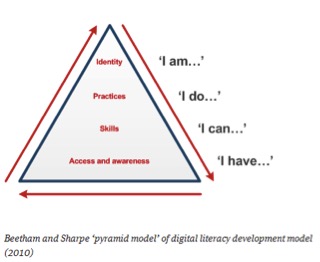
Key resources for the All Aboard project, and perhaps some of the most influential resources in the area of digital literacies and digital identity, have been those developed for Jisc by Helen Beetham, Lou McGill, Allison Littlejohn, Rhona Sharpe and others. A highlight of last week’s ePortfolio conference was Helen Beetham’s wonderfully wide-ranging keynote Digital identities: resources for uncertain futures? in which she wove the threads of her work in the areas of digital literacies and digital identities over the past several years. Referencing work on identity in the pre-digital age by Vygotsky, Goffman, Butler and others, Helen noted the diversity of perspectives; then as now variously anxious and playful, social and psychological. Helen then traced the development of her work in this area, beginning with the iconic model as part of the LLiDA (Learning Literacies for the Digital Age) project:
continuing on to the well-known Jisc 7 Elements of Digital Literacies model and finally to the latest Digital Capability Framework with its explicit focus on digital identity and wellbeing:

Beetham (2015) Revisiting digital capability for 2015
In her keynote and recent blog post What is Digital Wellbeing?, Helen describes how important she felt it was that ‘digital identity and wellbeing’ be the overarching element of the new digital capability framework:
I think it’s useful, and potentially radical, to suggest that digital capability includes self-care, and that self-care requires a critical awareness of how digital technologies act on us and sometimes against us, as well as allowing us to pursue our personal and collective aspirations in new ways.
Positioning wellbeing and self-care at the heart of institutional initiatives to build digital capability is both radical and vitally important. And it is just a start. Balancing privacy and openness, self-care and scholarship, is a tightrope walk for many. For individuals who are marginalised, in any respect, the risks of openness and networked participation are often even greater. Digital capability models and policies provide an important starting point for institutions. But without caring hands to craft them in specific contexts, and a willingness to co-create new paths with and for staff and students, the models will not yield their potential, i.e. to help individuals to develop powerful digital identities and gain opportunities for voice, influence and growth.
My thanks to Helen Beetham, the All Aboard project, Digital Champions (a staff-student partnership here at NUI Galway) and many others doing this valuable work. I’m happy to be learning and working alongside you.
Image source: CC BY-NC-SA 2.0 Ed Yourdon Even Elmo has a mobile phone (Flickr). This image is one of my favourites by the late Ed Yourdon (1944-2016) whose work in both software engineering and photography has inspired me, and many others, for years.


 catherinecronin